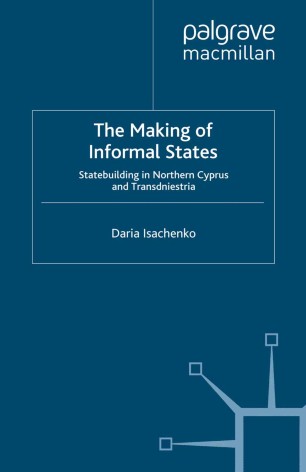
The Making of Informal States:
-
 Writen byDaria Isachenko
 - PublisherPalgrave Macmillan
- Year2012
Daria Isachenko’s The Making of Informal States explores the process of statebuilding in two de facto states—Northern Cyprus and Transdniestria—that lack international recognition but function with state-like structures. The book provides an in-depth comparative analysis of how these entities develop political, economic, and symbolic institutions to sustain themselves despite diplomatic isolation. Key themes include: • The Concept of Informal States – Examining how states without formal recognition operate and seek legitimacy. • Institutional Development – Analyzing the political and economic structures that sustain de facto states. • Symbolic Statebuilding – Investigating how flags, national identity, and history shape perceptions of legitimacy. • Economic Survival – Exploring trade, financial systems, and external support from patron states (e.g., Turkey for Northern Cyprus and Russia for Transdniestria). • International Relations – Assessing how these states interact with recognized international actors and organizations. • The Role of External Sponsors – Understanding the geopolitical influence of Turkey and Russia in sustaining these entities. The book offers an important contribution to understanding non-traditional state structures and their implications for global politics. This book is particularly relevant for understanding: • Unrecognized states and their implications for global peace (e.g., Palestine, Taiwan, Nagorno-Karabakh). • The role of international actors in sustaining breakaway regions (e.g., Russia’s influence on Donetsk and Luhansk). • Statebuilding efforts in post-conflict regions, especially in areas like Libya, where governance remains fragmented. • The intersection of political economy and peacebuilding in informal governance structures. This book is a valuable resource for studying conflict resolution, governance, and international legitimacy in unrecognized states. It provides deep insights into statebuilding beyond traditional frameworks