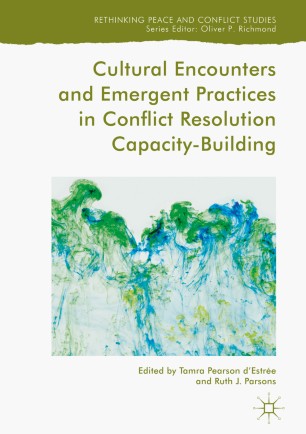
Cultural Encounters and Emergent Practices in Conflict Resolution Capacity-Building
-
 Writen byTamra Pearson d'Estrée and Ruth J. Parsons
 - PublisherPalgrave Macmillan
- Year2018
Cultural Encounters and Emergent Practices in Conflict Resolution Capacity-Building" explores the dynamic interplay between local cultural practices and institutional or Western models in the field of conflict resolution. Authors Tamra Pearson d'Estrée and Ruth J. Parsons compile a series of case studies that highlight partnerships forged between local practitioners and Western-trained experts. These collaborations have led to the development of innovative, hybrid approaches to mediation and conflict resolution. The book delves into central questions of cultural variation and integration, examining perceptions of conflict resolution processes, attitudes toward conflict, roles of third parties, and the challenges of remaining true to cultural contexts. It also analyzes partnership dynamics and offers lessons learned for modern cross-cultural collaboration. In an increasingly interconnected world, conflicts often span cultural and national boundaries. This book's focus on the fusion of indigenous practices with Western models provides valuable insights into creating effective, context-sensitive conflict resolution strategies. As global peacebuilding efforts continue to evolve, understanding how to navigate cultural encounters and integrate diverse practices is essential for developing sustainable solutions. Cultural Encounters and Emergent Practices in Conflict Resolution Capacity-Building" is a significant contribution to the discourse on peace and conflict studies. The authors' emphasis on real-world case studies offers practical insights into the complexities of cross-cultural collaboration in conflict resolution. This work is particularly valuable for scholars, practitioners, and policymakers seeking to enhance their understanding of culturally integrated approaches to peacebuilding. Strengths: • Empirical Case Studies: The inclusion of diverse case studies provides concrete examples of how cultural integration in conflict resolution can be achieved. • Interdisciplinary Approach: The book bridges multiple disciplines, offering a holistic perspective on the subject matter. • Practical Insights: Lessons learned from various partnerships offer guidance for future cross-cultural collaborations. Weaknesses: • Regional Focus: While the case studies are rich in detail, they may not cover all global contexts, potentially limiting the applicability of some insights. • Theoretical Depth: Readers seeking an in-depth theoretical exploration may find the practical focus of the book less comprehensive in that regard. Overall Rating: ★★★★☆ (4.5/5)