
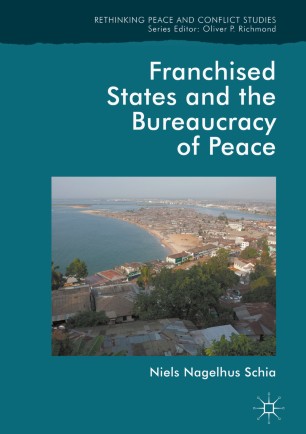
Franchised States and the Bureaucracy of Peace
-
 Writen byNiels Nagelhus Schia
 - PublisherPalgrave Macmillan
- Year2018
Franchised States and the Bureaucracy of Peace critically examines how international peacebuilding efforts operate through standardized bureaucratic frameworks that resemble franchise governance. The author, Niels Nagelhus Schia, explores how peace missions—primarily under the United Nations—employ rigid, hierarchical, and pre-designed structures that often fail to integrate local contexts effectively. Using empirical evidence from UN peacekeeping missions, the book dissects the contradictions between the goal of fostering state sovereignty and the reality of bureaucratic intervention. The study highlights how international organizations exert control through structured mandates, ultimately questioning whether this approach truly supports sustainable peace or merely reinforces dependency on global institutions. Relevance with the Current Era This book is highly relevant in today’s discourse on peacekeeping and state sovereignty, especially as global peace missions face scrutiny over their effectiveness. With increasing demands for localized peacebuilding, decolonized approaches, and bottom-up governance models, Franchised States and the Bureaucracy of Peace serves as an essential critique of the status quo. Its insights contribute to ongoing policy debates on how peace operations can transition from rigid bureaucratic control to more adaptive and inclusive frameworks that promote long-term stability and ownership by local actors. Final Verdict This book is a must-read for scholars, policymakers, and practitioners involved in peacebuilding, governance, and post-conflict reconstruction. It challenges mainstream narratives on international peace operations and highlights the unintended consequences of bureaucratic control. Given the increasing focus on adaptive, locally-driven approaches to peacebuilding, this book provides timely and critical reflections for the field.