
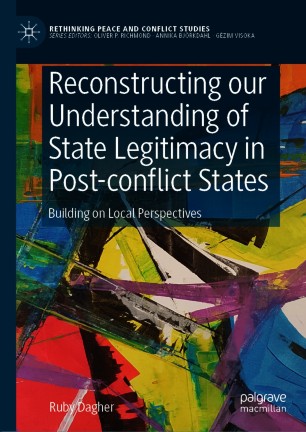
Reconstructing Our Understanding of State Legitimacy in Post-Conflict States:
-
 Writen byRuby Dagher
 - PublisherPalgrave Macmillan
- Year2021
This book is highly relevant given the increasing focus on post-conflict recovery and governance in fragile states. The study of state legitimacy is particularly important for understanding political stability, peacebuilding efforts, and governance challenges in post-conflict societies. With ongoing global conflicts, transitions from war to peace require frameworks that balance institutional rebuilding and local legitimacy. It aligns with United Nations Sustainable Development Goals (SDGs), particularly Goal 16: Peace, Justice, and Strong Institutions, by addressing governance and legitimacy issues. 1. New Approach to State Legitimacy: It offers an alternative framework for measuring and understanding state legitimacy in fragile and post-conflict societies. 2. Bridging the Gap Between Leaders and the People: The book provides insights into how local community perspectives can be incorporated into governance and legitimacy-building efforts. 3. Policy Relevance: The proposed Performance Legitimacy Theory of Transition (PLTT) offers a structured approach for policymakers, diplomats, and international organizations to engage with post-conflict governance. 4. Alternative Legitimacy Indicators: Introduces new, contextualized indicators to measure legitimacy beyond Western-centric models. 5. Strengthening Peacebuilding & Development Efforts: By challenging traditional state-building models, it advocates for locally driven peace and governance strategies.