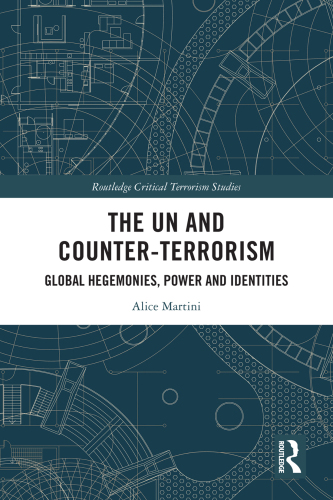
The UN and Counter-Terrorism: Global Hegemonies, Power and Identities
-
 Writen by Alice Martini
 - Publisher Routledge
- Year2021
The UN and Counter-Terrorism: Global Hegemonies, Power and Identities" examines the evolution of the United Nations Security Council's (UNSC) approach to combating terrorism and extremism. Alice Martini explores how the UNSC's actions have shaped global counter-terrorism efforts, focusing on the discursive construction of terrorism as a global threat. The book traces the development of legal practices and bodies established by the UNSC, analyzing how these are influenced by global power dynamics and the Council's own identity. Martini provides a genealogical perspective, starting from the 1930s and concentrating on significant developments in the 2000s, to illustrate how the UNSC's counter-terrorism initiatives have become global enterprises. Relevance to the Current Era In an era where terrorism remains a significant global concern, this book offers valuable insights into the role of international organizations, particularly the UN, in shaping counter-terrorism policies. Understanding the power relations and hegemonies that influence these policies is crucial for scholars, policymakers, and practitioners engaged in security and international relations. Martini's analysis sheds light on the complexities of global governance and the challenges in formulating effective and equitable counter-terrorism strategies. Final Verdict Alice Martini's work is a substantial contribution to critical terrorism studies and international relations. By dissecting the UNSC's counter-terrorism efforts through the lenses of power and identity, the book offers a nuanced understanding of how global hegemonies shape security policies. It is a valuable resource for those seeking to comprehend the intricate dynamics of global counter-terrorism initiatives and the UN's role in this domain. Evaluation of the Book Strengths: Comprehensive analysis of the UNSC's counter-terrorism evolution Critical examination of power dynamics and identity formation Genealogical approach providing historical context Relevance to contemporary global security challenges Weaknesses: Theoretical complexity may challenge readers unfamiliar with constructivist approaches Focus on the UNSC might overlook contributions from other UN bodies or regional organizations