
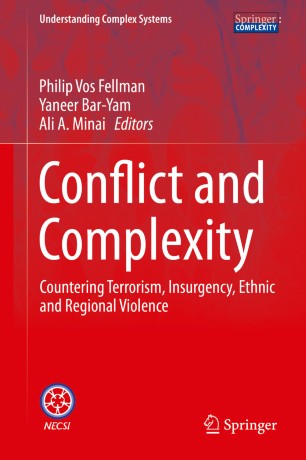
Conflict and Complexity:
-
 Writen byPhilip Vos Fellman, Yaneer Bar-Yam, Ali A. Minai (eds.)
 - PublisherSpringer
- Year2015
Conflict and Complexity: Countering Terrorism, Insurgency, Ethnic and Regional Violence delves into the use of complex adaptive systems to address global security challenges, particularly in the context of terrorism, insurgency, and ethnic violence. The book examines the dynamics of terrorist networks, offering new models for their analysis and disruption. It covers topics such as Dynamic Network Analysis, DIME/PMESII models, percolation models, and emergent models of insurgency, as well as agent-based social simulations of social identity dynamics. The book is informed by both theoretical frameworks and practical experience, drawing on contributions from authors with experience in the U.S. Department of Defense and the British Ministry of Defence. The authors provide policy guidance on countering terrorism and counterinsurgency efforts, incorporating real-world lessons into their models. The exploration also extends to the landscape of maritime piracy and the challenges of predicting adversary behavior in irregular warfare. Relevance with the Current Era along with Community Engagement Mechanism: This book is highly relevant in the current era as it addresses ongoing global challenges of terrorism and insurgency, particularly in regions facing ethnic and regional violence. The methodologies discussed, such as Dynamic Network Analysis and agent-based simulations, are applicable for modern counterterrorism efforts, enabling the identification and disruption of terrorist networks. The book’s focus on complex systems is crucial for understanding the evolving nature of warfare and insurgency in the digital age. Its practical applications can aid in developing community engagement mechanisms through the identification of social identity dynamics and the use of complex models to address societal conflicts. The policy guidance within can also inform rehabilitation programs and support efforts in counter-radicalization. This book is a sophisticated resource for those studying counterterrorism and insurgency in the context of modern complex networks. Its use of innovative models and interdisciplinary approaches offers new perspectives on addressing terrorism and violence, making it a valuable tool for both academic study and policy formulation. Although it is highly technical and focused on theoretical models, its real-world applications in counterterrorism provide practical insights. The book’s emphasis on complexity science offers an in-depth understanding of how terrorist networks and insurgencies evolve, making it particularly relevant to military strategists, policymakers, and academics in the fields of security studies and international relations.