
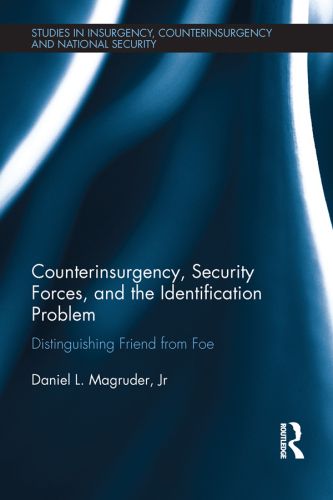
Counterinsurgency, Security Forces, and the Identification Problem:
-
 Writen byDaniel L. Magruder, Jr
 - PublisherRoutledge
- Year2017
Daniel L. Magruder Jr.'s book tackles a central problem in counterinsurgency (COIN) theory and practice: how can security forces distinguish insurgents from civilians? Drawing on empirical evidence and theoretical insights, the author develops a model suggesting that the behavior of security forces—particularly in terms of their respect for civilian safety—affects their ability to secure collaboration from the population. In contrast to conventional assumptions that military presence equals control, Magruder argues that genuine influence requires trust and credibility, which are undermined by excessive coercion or indiscriminate violence. The book outlines how positive civil-military relations and strategic behavior during operations can resolve the “identification problem” that hampers many COIN campaigns. Relevance in the Current Era & Community Engagement Mechanism This book is highly relevant for current and future COIN strategies, particularly in contexts where identifying non-state actors within civilian populations remains a core challenge (e.g., in urban insurgencies or hybrid warfare). Magruder's emphasis on civilian trust, population-centric warfare, and credible state behavior directly connects with modern peacebuilding and rehabilitation initiatives. It also highlights the importance of community engagement, ethical counterinsurgency, and legitimacy—key themes in rehabilitation and reintegration strategies used in post-conflict societies globally. The work aligns with peace-centric counterterrorism policies that emphasize soft power, legitimacy, and psychological operations, rather than brute force. Target Audience • Counterinsurgency strategists and military analysts • Peace and conflict resolution scholars • Civil-military relations specialists • Students and researchers in national security, IR, and conflict studies • Policymakers working in stabilization, DDR (Disarmament, Demobilization, Reintegration), and security governance