
Operation “Green Hunt” in India: ”
-
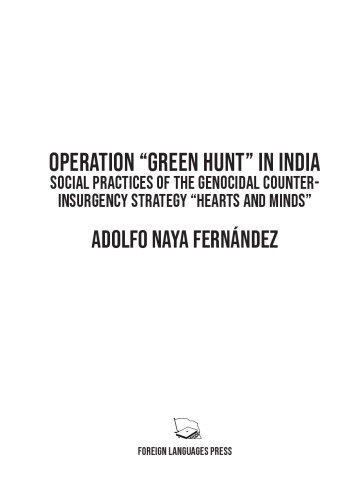
 Writen byAdolfo Naya Fernandez
 - PublisherForeign Languages Press
- Year 2020
In Operation “Green Hunt” in India: Social Practices of the Genocidal Counter-insurgency Strategy “Hearts and Minds”, Adolfo Naya Fernandez critically analyzes the Indian government's counter-insurgency operation, "Green Hunt," which targeted insurgent groups in central and eastern India, particularly the Maoist Naxalites. The book scrutinizes the "hearts and minds" strategy, which attempts to win over local populations by promoting development and social welfare, but it argues that in practice, the operation led to widespread human rights abuses and violence against marginalized communities. Fernandez explores the contradictions within the counter-insurgency tactics, presenting "Green Hunt" as a genocidal strategy under the guise of development, ultimately failing to resolve the insurgency and worsening the social fabric of the affected regions. Relevance with the Current Era along with Community Engagement Mechanism: The book holds significant relevance in today’s global context, especially in countries dealing with insurgencies and state responses. The "hearts and minds" approach, often used in counter-insurgency, has been critiqued for its often violent and oppressive outcomes, despite its ostensibly positive goals. This book offers an in-depth look at how such strategies play out on the ground, especially in marginalized communities, making it a crucial resource for understanding the dynamics of state power, insurgency, and the social consequences of military interventions. The focus on human rights abuses, violence, and state-sanctioned oppression provides valuable insights for anyone studying conflict resolution, political strategy, and the relationship between the state and its citizens in times of crisis.Operation “Green Hunt” in India is a critical examination of India's counter-insurgency strategy during the "Green Hunt" operation. The book offers a nuanced perspective on the operation's failure to address the insurgency effectively and its harmful effects on local communities. It is a well-researched and compelling resource that sheds light on the complex relationship between counter-insurgency strategies and human rights violations, particularly in the context of post-colonial states facing internal conflicts. The book is a crucial read for scholars of counter-insurgency, human rights, and political strategy.