
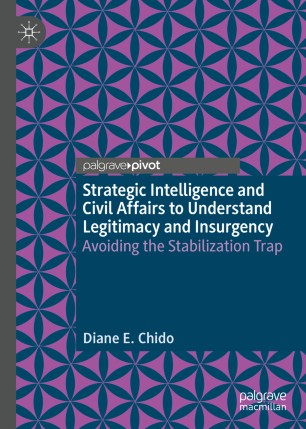
Strategic Intelligence and Civil Affairs to Understand Legitimacy and Insurgency:
-
 Writen byDiane E. Chido
 - PublisherPalgrave Pivot
- Year 2020
In Strategic Intelligence and Civil Affairs to Understand Legitimacy and Insurgency: Avoiding the Stabilization Trap, Diane E. Chido explores the shortcomings of U.S. military interventions in post-conflict societies, particularly in their attempts to stabilize regions after conflict. She identifies common pitfalls, such as a lack of understanding between military forces and the local populations they are trying to help, and the misalignment between military operations and political strategies. The book stresses the importance of integrating strategic intelligence and civil affairs into stabilization efforts, advocating for a relational approach over the more transactional and often lethal methods used in current military practices. Chido argues that sustainable stabilization can only be achieved through understanding local contexts, maintaining a focus on legitimacy, and promoting comprehensive engagement strategies that balance security with development. Relevance with the Current Era along with Community Engagement Mechanism Given the continuing relevance of military interventions in conflict zones, this book is highly significant for contemporary discussions on how best to engage in post-conflict stabilization. It provides a critical perspective on U.S. military strategies and emphasizes the need for a more thoughtful, long-term approach that fosters legitimacy and local empowerment. This work is highly relevant in light of recent and ongoing global military engagements and emphasizes the importance of strategic intelligence in understanding the dynamics of legitimacy and insurgency. Its focus on community engagement is vital for any efforts seeking to avoid the pitfalls of past interventions and instead build sustainable peace through mutual understanding and cooperation. Relevance with the Current Era along with Community Engagement Mechanism: Given the continuing relevance of military interventions in conflict zones, this book is highly significant for contemporary discussions on how best to engage in post-conflict stabilization. It provides a critical perspective on U.S. military strategies and emphasizes the need for a more thoughtful, long-term approach that fosters legitimacy and local empowerment. This work is highly relevant in light of recent and ongoing global military engagements and emphasizes the importance of strategic intelligence in understanding the dynamics of legitimacy and insurgency. Its focus on community engagement is vital for any efforts seeking to avoid the pitfalls of past interventions and instead build sustainable peace through mutual understanding and cooperation.Strategic Intelligence and Civil Affairs to Understand Legitimacy and Insurgency offers an insightful and critical analysis of the common errors in military stabilization efforts. By highlighting the importance of strategic intelligence and civil affairs, the book provides an alternative framework for military interventions that seeks to avoid the "stabilization trap" and prioritize legitimacy and local engagement. This makes it a valuable resource for military professionals, policymakers, and scholars interested in conflict resolution, international security, and military strategy.This book is targeted at military professionals, policymakers, scholars of international relations and security studies, and anyone involved in post-conflict reconstruction or stabilization efforts.