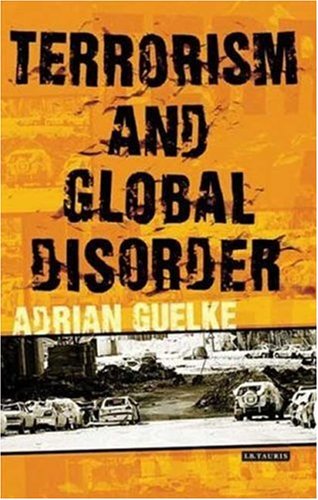
Terrorism and Global Disorder:
-
 Writen byAdrian Guelke
 - PublisherI. B. Tauris; distributed in the U.S. and Canada by Palgrave Macmillan
- Year2006
This book offers a critical examination of terrorism in the context of late 20th and early 21st-century global transformations. Adrian Guelke challenges the widely accepted notion that 9/11 fundamentally changed the world, arguing instead that terrorism's global reach stems from more significant geopolitical shifts—namely the end of the Cold War and the dissolution of bipolar superpower dominance. He explores how emerging technologies, global communications, and political exploitation have shaped the contemporary terrorism landscape. The book critiques the partisan misuse of counterterrorism and emphasizes the risk posed by politicizing security measures. This work provides essential insight into how terrorism evolves in response to geopolitical changes, rather than isolated catalytic events. Its analysis of global disorder is particularly relevant in a multipolar world where extremism thrives on fractured authority and misused security narratives. It is useful for designing academic courses, holding critical discussion panels, and producing awareness materials that challenge dominant narratives about global terrorism. This work provides essential insight into how terrorism evolves in response to geopolitical changes, rather than isolated catalytic events. Its analysis of global disorder is particularly relevant in a multipolar world where extremism thrives on fractured authority and misused security narratives. It is useful for designing academic courses, holding critical discussion panels, and producing awareness materials that challenge dominant narratives about global terrorism. This work provides essential insight into how terrorism evolves in response to geopolitical changes, rather than isolated catalytic events. Its analysis of global disorder is particularly relevant in a multipolar world where extremism thrives on fractured authority and misused security narratives. It is useful for designing academic courses, holding critical discussion panels, and producing awareness materials that challenge dominant narratives about global terrorism.