
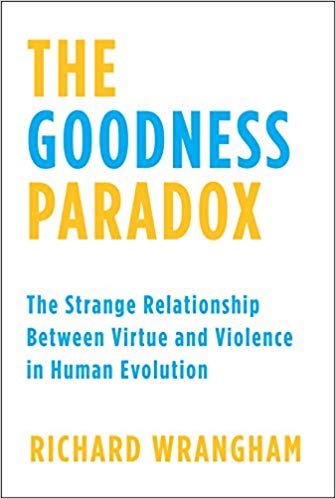
The Goodness Paradox:
-
 Writen byRichard Wrangham
 - PublisherPantheon Books
- Year2019 (29 January)
This book explores the paradoxical coexistence of virtue and violence in human evolution. It examines how Homo sapiens evolved to be both exceptionally cooperative and capable of extreme violence. Wrangham distinguishes between two types of aggression in primates—reactive and proactive—and traces their separate evolutionary paths. The book discusses how humans self-domesticated, the role of language acquisition, and the function of capital punishment in shaping culture and civilization. Through evolutionary biology and primatology, the author presents a compelling theory about the dual nature of human social behavior and its impact on peace and violence. In a world grappling with persistent violence despite advancements in civilization, this book offers critical insights into the biological and evolutionary roots of aggression and cooperation. Its findings are valuable for peacebuilding, conflict resolution, and community education programs that address the innate capacities for violence and prosocial behavior in humans. It encourages interdisciplinary approaches integrating biology with social sciences to understand and mitigate violence. A landmark interdisciplinary work providing a nuanced understanding of human aggression and cooperation, this book is an essential resource for scholars and practitioners in evolutionary biology, anthropology, and peace studies. The book's strength lies in its original synthesis of evolutionary biology and social theory, supported by extensive primatological data. It is both accessible and scholarly, making complex concepts understandable without sacrificing depth. However, its focus on biological determinants may underemphasize cultural and structural factors influencing violence. Compared to similar works, it stands out for its detailed analysis of aggression types and human self-domestication.