
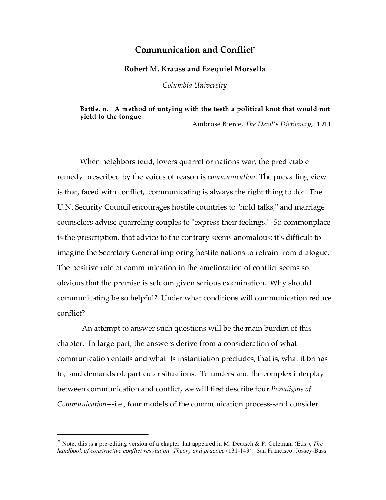
Communication and Conflict
-
 Writen byKrauss
 - PublisherNot provided
- YearNot provided
This analytical chapter/book challenges the universal assumption that communication inherently resolves conflict. Drawing from theoretical and practical lenses, Krauss dissects when, how, and under what conditions communication actually reduces tensions—be it among individuals, communities, or nation-states. The text critiques the simplistic "talk it out" approach and explores factors such as intention, context, power dynamics, and emotional readiness, which can either make communication a bridge or a barrier to peace. In a time of polarized societies, fragile international alliances, and rising ideological confrontations, this work serves as a critical reminder that not all communication heals. It urges strategic and context-aware dialogue. For community engagement, it can be used: • In conflict resolution training programs • For developing peace education curricula • In academic and practitioner settings to refine mediation techniques • In evaluating conflict communication failures (e.g., peace talks, public diplomacy) It complements the GRACE Repository’s mission by deconstructing myths around peacebuilding and offering nuanced, theory-driven mechanisms for actual transformation. An insightful and conceptually grounded resource that questions widely held assumptions and offers depth in understanding conflict dynamics. Ideal for trainers, mediators, scholars, and students of peace and dialogue.