
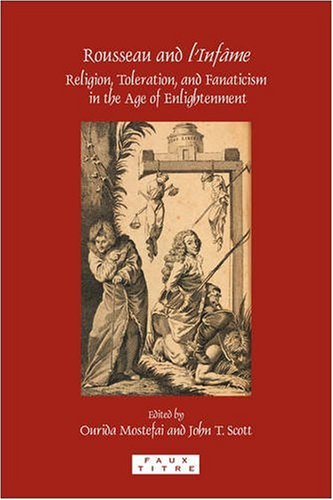
Rousseau and l'Infâme:
-
 Writen byJohn T. Scott, Ourida Mostefai
 - PublisherNot explicitly listed (likely Rodopi/Brill, as part of the "Faux Titre" series)
- Year2008
Rousseau and l'Infâme is a comprehensive philosophical and historical study of Jean-Jacques Rousseau's role in Enlightenment debates on religion, toleration, and fanaticism. Drawing on Rousseau’s controversial relationship with Voltaire’s campaign against “l’infâme” (a symbol for religious bigotry and clerical oppression), the authors dissect how Rousseau’s unique position defies the simplistic binaries of Enlightenment rationalism vs. religious traditionalism. Scott and Mostefai explore how Rousseau’s critiques of both fanaticism and unchecked rationalism shaped his understanding of religious authority, civic religion, and social cohesion. They show how Rousseau, unlike many Enlightenment peers, embraced a cautious form of civic religiosity—not to promote dogma, but to harness emotional and moral unity in the service of public good. The book positions Rousseau not only as a critic of clerical tyranny but also as a nuanced advocate for a moderated, emotionally resonant form of religion in political life. In an age of polarized secular-religious politics, the themes of this book are profoundly relevant. Rousseau’s insistence on balancing freedom of conscience with communal moral cohesion speaks to today’s debates about multiculturalism, laïcité (secularism), and religious symbolism in public life. From a community engagement standpoint, this book provides a rich intellectual resource to develop critical discussions on: • The limits of tolerance, • The role of religious identity in civil society, and • Preventing fanaticism without excluding spiritual frameworks. It can be used in interfaith education, public ethics seminars, and curriculum development in religious tolerance studies. This book is a foundational academic resource that delves into the philosophical roots of toleration, fanaticism, and Enlightenment critique through Rousseau’s often misunderstood legacy. Its relevance to both historical understanding and modern pluralistic governance is unquestionable. Although dense in scholarly content, its implications make it valuable to readers aiming to grasp ideological roots of fanaticism and the tension between secular and spiritual governance.