
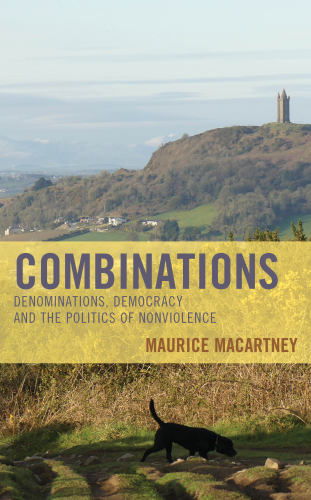
Combinations: Denominations, Democracy and the Politics of Nonviolence
-
 Writen byMaurice Macartney (born 1967).
 - PublisherLexington Books, an imprint of Rowman & Littlefield Publishing Group, Inc.
- Year2024
Combinations argues that much of contemporary political life is structured around what Maurice Macartney calls denomination: collective entities (communities, nations, races, sects) and the processes by which people are named, categorized, aligned, or excluded through those entities. Macartney begins with an analysis of denominational routines in Northern Ireland, then traces similar processes in the era of empire and enslavement, showing how violence (both direct hostility and systemic indifference) is embedded in the establishment and maintenance of denominational categories. He contends that populism and the global market often perpetuate or intensify these divisions. From there, Macartney shifts toward proposing an alternative politics: a nonviolent democratic practice that moves beyond hostile or indifferent relationships structured by denominational binaries. Central to this is the idea of neighbourhood democracy, where people act as “commoners on the one common,” cultivating relationships across differences and resisting the logic of “us vs them.” The book includes chapters on “Denomination: The Politics of Hostility,” “The Cold White Meat of Contract: The Politics of Indifference,” “The Gift,” “Donne’s Other Truth: Denomination Today,” “The Combination: Nonviolence and Democracy,” and concludes with a vision of neighbourhood democracy. It combines personal experience, philosophical reflection, analysis of political speech and institutions, and normative proposals. In today’s global environment of increasing polarization, identity politics, ethno-nationalist populism, and social fragmentation, Combinations addresses urgent challenges. The rise of political movements that emphasize binary oppositions (insider/outsider, friend/enemy) makes Macartney’s analysis of denomination and its violence particularly pertinent. Also, as democratic institutions are under stress, and as debates over immigration, race, religion, and national identity intensify, the proposal for a nonviolent democratic practice that transcends rigid partisan or identity boundaries offers timely theoretical and practical resources. Practically, the book can inform initiatives in peacebuilding, conflict transformation, intercommunal dialogue, grassroots democratic organizing, civic education, and identity reconciliation. Community engagement could take the form of workshops or seminars exploring “denomination” in local settings; dialogues that bring together groups with different denominational identities; creation of neighborhood assemblies or forums that test the idea of “neighbourhood democracy”; and public lectures or discussion series using Macartney's framework to analyze local or global crises of division. Combinations is a substantial and original contribution to political theory and the literature on nonviolence, identity, and democracy. It succeeds in both diagnosing important sources of contemporary political violence and offering a coherent, normative vision for how democratic life might be reimagined beyond denominational boundaries. It is a valuable work for scholars, practitioners, and activists interested in addressing division, identity politics, and nonviolent democratic alternatives.The strengths of the book include its lucid theorization of “denomination” as process, rather than merely identity, which deepens understanding of how divisions are formed and reproduced. The comparative and historical sweep (Northern Ireland, empire, modern identity politics) gives breadth; the normative vision of neighbourhood democracy offers a constructive alternative rather than mere critique. The prose is reported to be engaging and erudite. Weaknesses include that the work may assume a level of familiarity with political theory and philosophical vocabularies (e.g., performative speech-acts, friend-enemy distinction) that might limit accessibility for non-academic audiences. Also, while the normative vision is powerful, there might be challenges in operationalizing neighbourhood democracy in highly divided or resource-scarce contexts. Compared to other works in peace and nonviolence (e.g. classics by Gene Sharp, Mary Kaldor, or recent works on polarization by Pippa Norris or Yascha Mounk), Macartney is more theoretical and less empirical in large cross-case studies; his case focus (Northern Ireland etc.) is strong but less global. In terms of scholarly depth, the book is rigorous; in accessibility, it is more suited to readers with some grounding in political theory; impact potential is high in academic, NGO, and activist environments.