
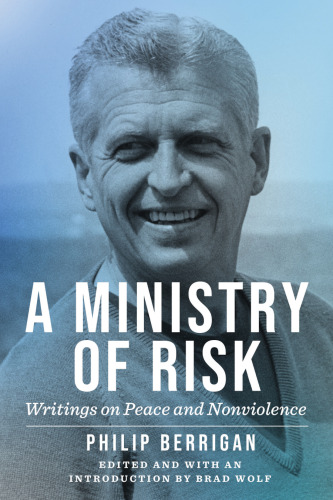
A Ministry of Risk:
-
 Writen byPhilip Berrigan; Edited by Brad Wolf; Foreword by Bill Wylie-Kellermann; Preface by Frida Berrigan; Afterword by John Dear
 - PublisherFordham University Press, New York
- Year2024
A Ministry of Risk is a chronological collection of Philip Berrigan’s writings, speeches, letters, and reflections spanning roughly from 1957 until his final journal entries in 2002. Edited by Brad Wolf and authorized by the Berrigan family, the book presents Berrigan’s transformation from a soldier and Christian priest into a prophet of nonviolent resistance. It addresses major themes such as war and militarism; nuclear weapons; systemic racism and materialism; the role of the Church and Christian witness; civil disobedience and imprisonment; faith, suffering, and sacrifice. The book is divided into three major parts: (i) “A Catholic Trying to Be a Christian” (1957-67), dealing with early theological formation, crises over war and nuclear arms, civil rights; (ii) “Resisting the Vietnam War” (1967-73), focusing on direct action, nonviolent resistance, and the trials and jails stemming from that activism; (iii) “Community, Plowshares, and the Bomb” (1973-2002), which explores community life, nuclear disarmament, radical protest (including the Plowshares movement), reflections from prison, and Berrigan’s final statements. The book weaves autobiography, theological reflection, prophetic critique of U.S. militarism, and pastoral theology of resistance.The book is highly relevant in the present day, given global challenges including renewed great-power rivalry, nuclear weapons modernization, systemic racism, climate change (which intersects with militarism), and rising militarism in domestic politics. Berrigan’s critique of the “culture of war” and his insistence on moral and prophetic witness resonates with movements today that seek nonviolent change (e.g. anti-nuclear campaigns, peace movements, racial justice movements). Practically, the book can influence activists, theologians, policy makers, religious communities, and educators. Its insights into how to sustain resistance over decades, how to integrate faith & action, and how to endure suffering without losing moral clarity are of real use in community organizing, peace education, and nonviolence trainings. Community engagement might include study groups in churches or peace organizations, interfaith forums discussing nonviolence and militarism, workshops for young activists using Berrigan’s writings as case studies, artistic or memorial events that reflect on war and resistance, and public lectures drawing connections between Berrigan’s era and current conflicts. A Ministry of Risk is a significant and timely contribution to literature on peace, nonviolence, and prophetic Christian activism. Its breadth, archival depth, and moral urgency make it a valuable resource. It both preserves the legacy of a pivotal figure and offers moral and practical guidance for confronting contemporary violence and injustice.