
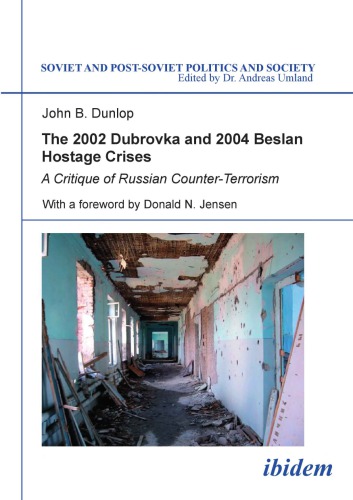
The 2002 Dubrovka and 2004 Beslan Hostage Crises:
-
 Writen byJohn B. Dunlop
 - Publisheribidem-Verlag City: Stuttgart
- Year2006
The book offers a detailed critique of Russian state responses to two major hostage crises: the October 2002 seizure of the Moscow theatre at Dubrovka and the September 2004 school siege at Beslan. Dunlop examines both the background of the extremist perpetrators—including ethnic Chechens and Ingush militants—and the failures of Russian law enforcement and security services to prevent or manage the crises effectively. He documents alleged corruption within the Russian security apparatus, questions the rule of law, and analyzes the operational details of the storming of the hostage locations including the use of a special gas at Dubrovka and heavy military hardware at Beslan. Dunlop further argues that the Russian leadership under Vladimir Putin framed the events as international Islamist terrorism aligned with Al‑Qaeda, while attempting to marginalize moderate separatist voices. He uses official reports, commission findings, NGO and press sources to reconstruct the events and draw critique of Russian counter‑terrorism strategy.In the context of contemporary threats posed by terrorism, hostage incidents, and state responses, the book remains highly relevant for understanding how counterterrorism is practiced, justified, and critiqued in a major power state. Its detailed case studies provide insight into the limits of state policy, the human cost of security failures, and the importance of transparency, rule of law and ethics in anti‑terror operations. For community engagement and rehabilitation programs, the work can inform curricula about how extremist violence is operationalised, how state responses may exacerbate risks or create grievances, and how victims’ voices and accountability are often overlooked. It thus has utility for practitioners working in victim‑support, policy advocacy, training for security professionals, and educational work oriented toward prevention of radicalisation. Through its critique, the book can help inform community dialogues on trust in institutions, the ethical dimensions of force, and the necessity of rights‑based approaches in counterterrorism.This book is a significant contribution to the field of terrorism and counterterrorism studies, particularly with respect to Russian and post‑Soviet contexts. It provides depth in its case study focus and offers a critical lens on state practice rather than simply descriptive reportage. The book is of high value for scholars, policymakers, security practitioners and those concerned with human rights in the context of state counter‑terror operations.Strengths of the book include its thorough research into two major incidents, use of multiple source types, and clear articulation of the connection between state policy, institutional failure, and human impact. Its unique contribution lies in linking the operational detail of hostage crises with broader questions of state legitimacy, rule of law and counterterror strategy. A notable weakness is the reliance on source material that may be partial or contested (as acknowledged by reviews) and the focus on the Russian context may limit direct applicability to other regions without adaptation. Compared with other counterterrorism literature, this title stands out for its detailed Russian case‑study focus rather than generalized global overview. It achieves a balance between accessibility (for advanced students/practitioners) and academic rigor, though readers may need background knowledge in Russian politics or conflict studies for full comprehension.