
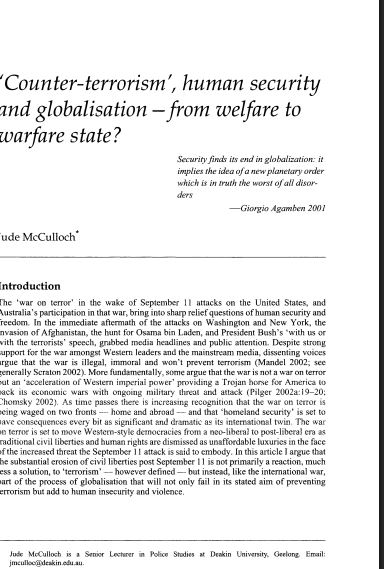
Counter‑terrorism’, Human Security and Globalisation — From Welfare to Warfare State?
-
 Writen byJude McCulloch
 - PublisherAustralian Institute of Criminology (publisher of Current Issues in Criminal Justice)
- Year2003
In this article, Jude McCulloch examines how the post‑September 11 “war on terror” has foregrounded human security concerns and the increasing blurring of boundaries between crime control and national security. The author argues that Western states – using Australia as a case study – are shifting from a welfare‑state model to a “warfare state” logic, wherein civil liberties and the rule of law are subordinated to perceived terrorism threats. McCulloch traces how globalisation, the intensification of security rhetorics and the home/abroad duality of the “war on terror” facilitate a state of exception where preventive policing, surveillance and “homeland security” become normalized. The article contends that rather than solving terrorism, this shift may exacerbate human insecurity and erode democratic freedoms.The article remains highly relevant today, as debates over counter‑terrorism, pre‑emptive security measures, the securitisation of migration and the erosion of civil liberties continue in many democracies. Its insights can inform community engagement efforts by encouraging critical reflection on how security policies affect minority communities, civil rights and social trust. For example, community dialogues and educational workshops might use this framework to examine how surveillance, profiling and exception‑based policies impact social cohesion, radicalisation risks and citizen‑state relations. Moreover, in the context of rehabilitation and extremism prevention, the article offers a lens through which to assess the unintended consequences of heavy‑handed security responses and to promote inclusive approaches grounded in human security rather than merely state security.This article presents a compelling and timely critique of the transformation of security governance in the post‑9/11 era. It is a valuable contribution to discussions on how globalisation, state power and counter‑terrorism intersect with human rights and social justice.The article’s strengths include its clear theoretical framing of the welfare‑to‑warfare state transition, its connection of globalisation and domestic security policy, and its critical attention to civil liberties and democratic implications. It draws on timely examples and engages with broader socio‑political shifts in security discourse. A limitation is that it uses primarily Australian and Western contexts, which may reduce its direct applicability to non‑Western states or varying political systems. Also, as an article, it provides a broad critique rather than extensive empirical case studies. Compared to other works in security and counter‑terrorism studies, McCulloch’s contribution is notable for foregrounding the human security dimension and the normalisation of exception in democratic settings. Its conceptual clarity and relevance make it accessible to scholars, policymakers and practitioners interested in security transitions, rights erosion and globalisation’s impact on state governance.