
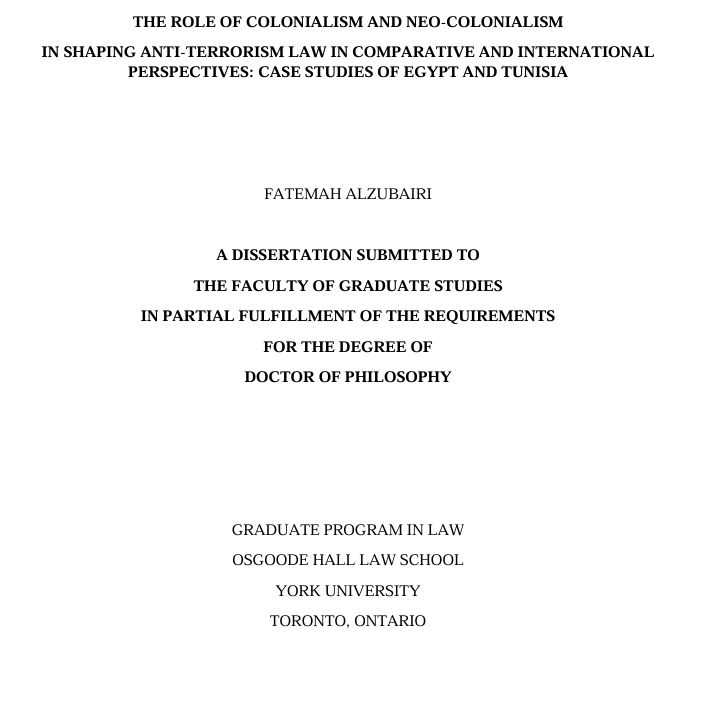
The Role of Colonialism and Neo‑Colonialism in Shaping Anti‑Terrorism Law in Comparative and International Perspectives:
-
 Writen byFatemah Alzubairi (Doctor of Philosophy PHD)
 - PublisherLaw, Osgoode Hall Law School, York University, Toronto, Ontario, Canada
- YearJanuary 2017 (Award
In this doctoral dissertation, Fatemah Alzubairi examines how colonial and neo‑colonial legacies have shaped anti‑terrorism legislation in Egypt and Tunisia. Drawing on comparative and international perspectives, the study argues that contemporary anti‑terror frameworks in these states cannot be fully understood without considering colonial practices of militarism, exceptional rule and centralized control, and how these practices were continued or transformed in the post‑colonial era. The research uses case studies of Egypt and Tunisia to trace how British and French colonial rule instilled legal and administrative templates for exceptional state power and counter‑insurgency, which have been carried forward into modern laws on terrorism. Additionally, the dissertation investigates the influence of global counter‑terror obligations (such as UN Security Council resolutions) and how they intersect with neo‑colonial dynamics in shaping executive‑oriented anti‑terror regimes. The work provides a detailed historical, legal and political account, arguing that both colonialism and neo‑colonialism are foundational for understanding the structure and operation of counter‑terror laws in Egypt and Tunisia.This dissertation offers strong relevance for the current era as it probes the structural underpinnings of counter‑terrorism legislation in major Arab states and connects these to broader themes of colonial legacy, governance, human rights and state security. For community engagement, its findings can inform educational programmes, public policy debates and civil society discussions about how anti‑terror laws may reflect historical patterns of state control rather than simply contemporary threat responses. It can support training modules for legal practitioners, human rights activists, inter‑faith dialogue facilitators and rehabilitation programmes by contextualizing how laws may inadvertently contribute to marginalisation, state‑citizen distrust and governance deficits. The research bridges grassroots concerns (rights, security, state accountability) with macro‑structural insights (colonialism, neo‑colonialism, globalisation), providing a valuable framework for practitioners working to promote more inclusive, rights‐based approaches to counter‑terrorism and social cohesion.The dissertation is a rigorous and significant academic contribution that illuminates the often overlooked historical and structural dimensions of anti‑terrorism law in post‑colonial Arab states. It provides both theoretical depth and empirical insight, making it a valuable resource for scholars, policymakers and practitioners seeking to understand the origins and impact of counter‑terror legislation in Egypt, Tunisia and similar contexts