
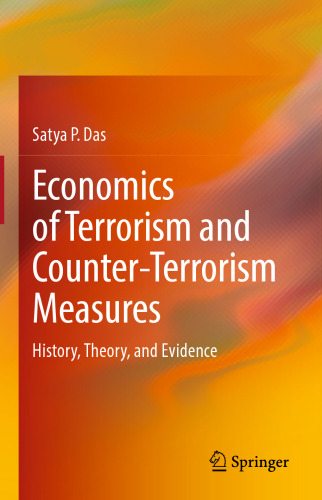
Economics of Terrorism and Counter-Terrorism Measures:
-
 Writen bySatya P. Das
 - PublisherSpringer (Springer Nature Switzerland AG)
- Year2022 (July 20)
This book presents a systematic economic-analysis approach to terrorism and counter-terrorism. Key features include: A historical overview of terrorism: origins, objectives, major organizations. SpringerLink +1 Trends and patterns in terrorism over time. catalog.k8s.libraries.psu.edu Financing, costs and consequences of terrorism; economic costs of counter-terrorism. IDEAS/RePEc +1 Behaviour, internal organisation, and survival of terror groups. SpringerLink Direct counter-terrorism measures: ‘security’, deterrence, preemptive strikes, financing, hostage taking. SpringerLink Preventive and root-cause measures: religious orthodoxy, breeding grounds of terrorism, combining preventive with preemptive. akademikabedrift.no Appendices: game theory, econometric/statistical methods for readers with economics background.The book addresses a critical need: understanding terrorism not just as a security problem, but as an economic decision-making problem—how states choose and resource counter-terrorism measures. With increasing attention on the costs and trade-offs of counter-terrorism (financial, social, civil liberties), this book is timely for policymakers and researchers. Its quantitative and model-based approach helps strengthen the evidence base around what works (and what doesn’t) in counter-terrorism policy. Given the evolving nature of terrorism (cyberterrorism, lone-actor attacks, financing through digital means), the book offers frameworks that can adapt to newer phenomena. Also relevant for multi-disciplinary scholars—those combining economics, security studies, and policy analysis.Strengths: Rare in that it combines economic theory, empirical evidence and policy discussion in the counter-terrorism field—bridging disciplines. Comprehensive scope: covers history, organization, costs, counter-measures, root causes. The inclusion of appendices on game theory and econometrics makes it accessible to readers with some quantitative background. Published recently (2022), so relatively up-to-date compared to many older texts. Limitations: Requires some prior knowledge of economics (micro theory, utility maximisation, cost minimisation) and statistics/regression. This may limit accessibility for purely qualitative scholars. Bol While comprehensive, the field of terrorism is rapidly shifting (e.g., AI, cyber-financing, lone-actors) — so some newer dynamics may not be extensively covered. Being a textbook, it may provide broad strokes rather than deep granular case studies for every region or conflict. Overall Assessment: A valuable and forward-looking resource for anyone researching or practicing in counter-terrorism policy, economics of security, and serious academic study of terrorism. Particularly strong for those seeking to integrate quantitative analysis with strategic/policy insights.