
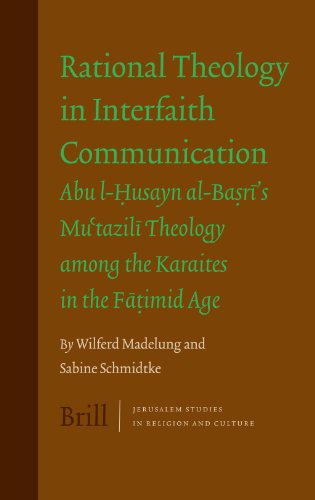
Rational Theology in Interfaith Communication:
-
 Writen byWilferd Madelung, Sabine Schmidtke
 - PublisherBrill (Leiden & Boston)
- Year2006
Focuses on rational speculative theology (kalam) in early Islam, particularly the Mu'tazila school founded in Basra in the early 8th century. The Mu'tazila emphasized that the basic truths of theology—such as God’s existence, attributes, and justice—can be established entirely through reason before scriptural proof. Scripture verification is secondary to rational proof, and the primacy of reason governs the interpretation of scripture. This approach facilitated interfaith communication, appealing to rational theologians from other scriptural religions, especially Karaites in Judaism. Mu'tazili influence on Jewish thought is traced from the 9th century, peaking in the 10th century, highlighting cross-religious theological engagement.