
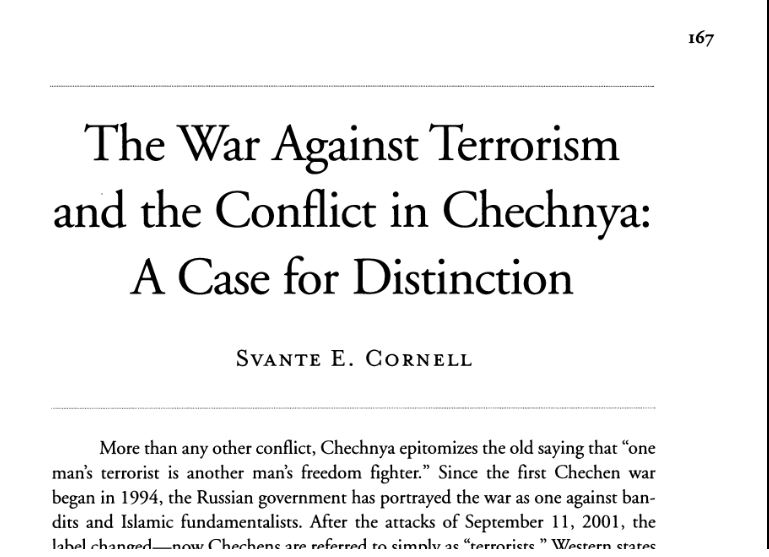
The War Against Terrorism and the Conflict in Chechnya:
-
 Writen bySvante E. Cornell
 - PublisherThe Fletcher Forum of World Affairs, Volume 27, Issue 2 (Summer/Fall)
- Year2003
In this article, Cornell argues that the Russian-Chechen conflict should not be simplistically labeled as part of the “War on Terror”: while Chechen insurgents are sometimes portrayed as terrorists, the conflict has strong ethno-nationalist and secessionist roots that differentiate it from purely ideological jihadist movements. He warns that conflating these distinct types of conflict can mislead both Western policymakers and analysts, resulting in misguided strategies that overlook legitimate grievances and fuel further instability. The article is highly relevant even today: the way states frame irregular violence influences counterterrorism policy, legitimacy, and external support, and Cornell’s insights help unpack how narratives around “terrorism” can either escalate or de-escalate conflict. For researchers and practitioners, this piece provides a conceptual lens to distinguish between asymmetric war and terrorism — a distinction that remains critical in many modern conflicts beyond Chechnya.Cornell’s article is strong in its clear conceptual distinction and policy relevance, offering a nuanced critique of the “terrorism or war” dichotomy. Its reliance on political and historical analysis rather than sensational framing gives it depth. One limitation is that it was published in 2003 and does not fully account for later developments—such as the growth of Islamist networks in the Caucasus or the impact of globalization on insurgent movements. It also primarily considers state framing and may underemphasize local civilian perspectives. However, its theoretical clarity and policy implications make it an influential contribution.A foundational and insightful article that remains highly relevant for understanding the complexity of modern insurgencies and the risks of mislabeling conflict as terrorism. Essential reading for security scholars and policymakers analyzing state narratives and counterterrorism strategies.